The Spirit of Restoration

Church History

There can be no restoration without the spirit of restoration which is the desire to take the New Testament as the standard of obedience. One cannot have the spirit of restoration without completely laying aside all human creeds, decrees of popes, and religious organizations unknown to the New Testament. Here are some vital facts that we must know and believe about the New Testament if we are to be successful in restoring New Testament Christianity: (1) The New Testament is divine – from God (2 Tim. 3:16-17); (2) It is authoritative (John 12:48); (3) It is intelligible (Eph. 3:4; 5:17); (4) It is universal (Mark 16:15-16); (5) It needs no revision (James 1:25; 1 Cor. 13:10); (6) It is sufficient (2 Tim. 3:16-17); and (7) It has life and power to bring the church into existence any time men choose to let it have its way in their lives (Luke 8:11; Heb. 4:12).

So I say to you, brother or sister in Christ, are you interested in restoring New Testament Christianity, or do you find yourself blindly following the popular crowd without seriously checking to see whether or not your practice is after the New Testament order? Remember, we are the Lord’s church ONLY if we walk according to God’s divine truth (1 John 2:19; 1 Cor. 11:19)!


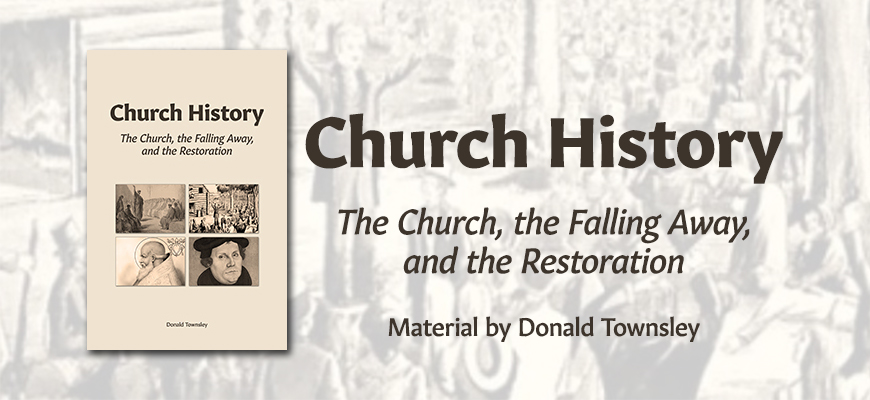
The above post is an excerpt from the book, Church History: The Church, the Falling Away, and the Restoration by Donald Townsley. Follow the link to learn more about the book and purchase your copy today!
NEW RELEASE: Church History

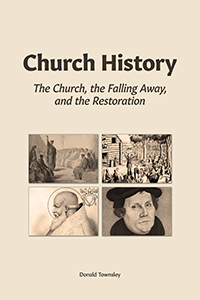
We are happy to announce that our newest book – Church History: The Church, the Falling Away, and the Restoration by Donald Townsley – is now available!

Church History (cover)Download a sample of the book!

A study of church history helps us understand present-day conditions in the religious world and the origin of the various denominations. It also helps us to have a greater appreciation for the church in the New Testament. This study should serve as a warning against the introduction of innovations and errors, no matter how innocent and insignificant they may appear.

Donald Townsley (1931-2013) was a preacher of the gospel of Christ who devoted himself to that work for over fifty years. In Church History, Townsley outlines the history of the church, departures from the faith that led to the formation of various denominations, and attempts at reformation and later restoration. Special emphasis is given to the Restoration Movement and various issues that impacted churches of Christ in the 20th century.

Townsley’s ability to condense a vast amount of information into a concise volume arranged in an easy to digest outline makes this book a valuable reference work for anyone interested in a history of the church, the falling away, and the restoration.

Read more about this new book and purchase your copy today!

If you would like to place a bulk order, please contact us.

Special Offer

For a limited time, save 15% off this book when you place an order through the Gospel Armory Store! Hurry, this offer is good through November 30, 2019.

When Persecution Arises

Regular Christians: The Importance of Each Member in the Body of Christ

Often when persecution arises against the church, it will be the “leaders” who are targeted – elders, preachers, or others who are seen as strong and influential members of the church. This is designed to stop the “followers” in the church. This may work in man-made organizations and groups (cf. Acts 5:36-38); but in the Lord’s church, we are not following men – we follow Christ. Jesus taught that all who follow Him – regardless of whether they were official or unofficial “leaders” in the church – must be willing to endure persecution: “Blessed are you when people insult you and persecute you, and falsely say all kinds of evil against you because of Me. Rejoice and be glad, for your reward in heaven is great” (Matthew 5:11-12). When we are persecuted, we “share the sufferings of Christ” (1 Peter 4:13) as we follow Him.

Antipas lost his life when he refused to deny the faith. The promise stated to the church at Smyrna would have applied to him as well: “Be faithful until death, and I will give you the crown of life” (Revelation 2:10). That promise also applies to us today. Death is a certainty for each one of us (Hebrews 9:27), yet we do not know when that time may be. It is possible that it could be hastened by persecution. If that is the case, let us follow the example of Antipas, the Lord’s “faithful one,” and remain faithful no matter what the cost.


The above post is an excerpt from the book, Regular Christians: The Importance of Each Member in the Body of Christ by Andy Sochor. Follow the link to learn more about the book and purchase your copy today!
Poverty and Inequality

Regular Christians: The Importance of Each Member in the Body of Christ

Contrary to the way that many people want to portray Jesus, He did not come to bring social and economic equality. When someone demanded, “Teacher, tell my brother to divide the family inheritance with me,” He did not try to settle this “unfair” situation; instead, He said, “Man, who appointed Me a judge or arbitrator over you?” (Luke 12:13-14). He bluntly told His apostles, “For you always have the poor with you” (Matthew 26:11). This means that poverty and inequality are still going to exist, and it could be that even faithful Christians will have to endure this type of hardship. Because of this, there are at least three things we need to do:

  • Learn contentment – Paul faced times of “humble means” and “prosperity”; yet in every situation he “learned to be content” (Philippians 4:11-12).
  • Store up treasures in heaven – Jesus said these treasures cannot be destroyed or stolen (Matthew 6:20); therefore, they are preferable. We can store up these treasures no matter what our financial/economic situation is in this life.
  • Put spiritual things first – Jesus said, “But seek first His kingdom and His righteousness, and all these things will be added to you” (Matthew 6:33). The things that pertain to our relationship with God and our future and eternal hope must be a priority over everything else.

It may still be difficult to endure social and economic inequality. Life may not seem “fair.” However, that should not be our primary concern. Paul wrote, “Each man must remain in that condition in which he was called. Were you called while a slave? Do not worry about it; but if you are able also to become free, rather do that” (1 Corinthians 7:20-21). Yes, being freed from slavery (or any other oppressed/disadvantaged condition) is preferable; but we can still faithfully serve God regardless of our status.

We do not know if Onesimus was ever freed by Philemon. Given his master’s character, we can assume that he would have either freed him or at the very least he would have treated him with fairness and respect as a fellow brother in Christ. Yet by returning, Onesimus showed that he was willing to submit to his master, whatever that might require. In every society, there are some who are richer and reside in a higher “class” than we do. Rather than bemoan this reality, let us simply determine to serve the Lord as He desires no matter what our place in society might be.


The above post is an excerpt from the book, Regular Christians: The Importance of Each Member in the Body of Christ by Andy Sochor. Follow the link to learn more about the book and purchase your copy today!

Providing Help from the Sidelines

Regular Christians: The Importance of Each Member in the Body of Christ

Jesus said, “A city set on a hill cannot be hidden” (Matthew 5:14). Not only is a city like this visible, it becomes a target by the enemy. Those who take a more public role in the fight for the cause of Christ generally will be targeted more directly by the enemies of Christ. We cannot take someone’s place in these battles. Yet we can provide help “from the sidelines” to strengthen them. For preachers, we can “support such men, so that we may be fellow workers with the truth” (3 John 8). For elders, we can “submit to them” and be a source of “joy and not…grief” (Hebrews 13:17). For those who are struggling with the discouragement of an unfaithful spouse or child, we can “encourage the fainthearted” (1 Thessalonians 5:14).

Aquila and Priscilla provided direct and timely help for Paul in his work of preaching. We often think of supporting preachers as a work of the church – which it certainly is (1 Corinthians 9:14; 2 Corinthians 11:8). However, it is much less of a burden to do the work of preaching the gospel (or be involved in the other situations like the ones we discussed) when brethren take a direct, personal interest in providing the support and encouragement that is sorely needed.


The above post is an excerpt from the book, Regular Christians: The Importance of Each Member in the Body of Christ by Andy Sochor. Follow the link to learn more about the book and purchase your copy today!