We Must Hate Every False Way

The Psalm of the Word: A Study of Psalm 119

From Your precepts I get understanding; therefore I hate every false way” (Psalm 119:104).

The world wants us to be tolerant toward sin and error to the point that we cannot even call anything sin and error. Yet David said that his understanding of God’s precepts led him to “hate every false way.

The same should be true for us. We should “hate every false way” because God hates it. The psalmist wrote elsewhere, “For You are not a God who takes pleasure in wickedness; no evil dwells with You. The boastful shall not stand before Your eyes; You hate all who do iniquity. You destroy those who speak falsehood; the Lord abhors the man of bloodshed and deceit” (Psalm 5:4-6).

Furthermore, we should also “hate every false way” because sin causes souls to be lost. Sin separates man from God (Isaiah 59:2) and “the wages of sin is death” (Romans 6:23). If we understand God’s word, we cannot help but hate what is false.


The above post is an excerpt from the book, The Psalm of the Word: A Study of Psalm 119. Follow the link to learn more about the book and purchase your copy today!
We Must Avoid Sin and Keep a Clear Conscience

The Psalm of the Word: A Study of Psalm 119

They also do no unrighteousness; they walk in His ways” (Psalm 119:3).

Then I shall not be ashamed when I look upon all Your commandments” (Psalm 119:6).

Many believe that Christians can “continue in sin” (Romans 6:1) without concern. Paul refuted this error and asked the question: “How shall we who died to sin still live in it?” (Romans 6:2). Jude indicated that those who teach this error have perverted the word of God by turning it into a “license for immorality” (Jude 4, NIV).

Our goal must be to “do no unrighteousness” (Psalm 119:3). John said that his first epistle – and by principle, all of the Bible – was written “so that you may not sin” (1 John 2:1). God’s “commandments are righteousness” (Psalm 119:172). Paul wrote, “All Scripture is inspired by God and profitable for teaching, for reproof, for correction, for training in righteousness” (2 Timothy 3:16). In order to “do no unrighteousness” (Psalm 119:3) and “not sin” (1 John 2:1), we must follow the righteous instructions found in God’s word.

David also indicated that God’s people should keep a clear conscience (Psalm 119:6). However, this does not mean that we keep ourselves free from guilt by ignoring God’s word and adopting a human standard. Paul persecuted Christians in good conscience (Acts 23:1). Our conscience must be trained by the word of God (Hebrews 5:13-14). Once our conscience is properly trained and we observe the commandments of God, we will not need to be ashamed as we examine our lives by God’s perfect standard.


The above post is an excerpt from the book, The Psalm of the Word: A Study of Psalm 119. Follow the link to learn more about the book and purchase your copy today!

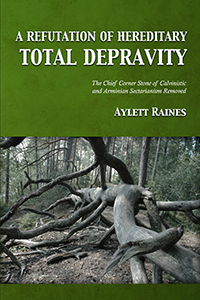
NEW RELEASE: A Refutation of Hereditary Total Depravity

A Refutation of Hereditary Total DepravityWe would like to announce our newest title – A Refutation of Hereditary Total Depravity by Aylett Raines – is now available. This is a reprint of a public domain book that has been out of print. It was originally published in 1859.
Raines was converted from Universalism after hearing the gospel preached by Walter Scott. He went on to preach the gospel and was a contemporary of men like Scott, Thomas Campbell, and Alexander Campbell.

This is the fourth release in our Ancient Landmarks Collection. This collection is made up of materials that have been produced by those associated with the Restoration Movement. More titles will be added to this collection in the future. Be sure to subscribe to our mailing list to be notified of new releases.

[Note: When you subscribe to our mailing list, you will also receive a free ebook – The Foundation for a Godly Society.]

A Refutation of Hereditary Total Depravity provides a thorough examination of the Calvinistic doctrine of total depravity and original sin and explains from the Scriptures why the doctrine is false. Read more about the book and purchase your copy today!

Bad Men Can Become Worse (Excerpt)

The following is an excerpt from the book, A Refutation of Hereditary Total Depravity by Aylett Raines.

That all unregenerate men are not equally, and, consequently, not totally depraved or wholly inclined to all evil, we will now prove from the Scriptures, by a few out of the many passages which might be adduced. Paul says that “evil men and seducers shall wax worse and worse.” Now, it must be admitted that evil men and seducers are unregenerate men. How, then, can these men, by nature totally depraved, become worse and worse? Worse than totally depraved? Worse than wholly inclined to all evil? Impossible! Every reader, who is not blind, can certainly perceive that if bad men can become worse, they are not by nature totally depraved!

You can read more in A Refutation of Hereditary Total Depravity. Follow the link to learn more about the book and purchase your copy today!

Take Courage: Lessons from the Example of Joseph (Excerpt)

The following is an excerpt from the book, Take Courage: Eight Lessons from Men of Faith.

Take Courage (cover)Joseph’s example provides several lessons for us.

First, we must maintain sexual purity in order to please God. We are to respect God’s arrangement for fulfilling these natural desires – marriage (Hebrews 13:4; 1 Corinthians 7:1-2). But even without marriage, we must resist temptation (1 Corinthians 10:13). When Paul wrote to Timothy – a young, unmarried man – he told him to treat “younger women as sisters, in all purity” (1 Timothy 5:2). He was not to flirt with sin and see how close he could get to it.

Second, we must be faithful to God, even if we must stand alone. Though he would later deny Jesus, Peter’s initial attitude was commendable: “Even though all may fall away because of You, I will never fall away” (Matthew 26:33). If brethren forsake, desert, or mistreat us, it is discouraging; but we must remain faithful anyway (2 Timothy 4:16-17).

Third, we must remain steadfast, even if temptation is persistent. Peter warned his readers: “Be on your guard so that you are not carried away by the error of unprincipled men and fall from your own steadfastness” (2 Peter 3:17). It is possible for one to be steadfast but eventually give in to error and sin and fall away.

Fourth, we must avoid sin, even if we think no one will find out. Even if it might be possible to sin with no other human being aware of our transgression, God will know. “And there is no creature hidden from His sight, but all things are open and laid bare to the eyes of Him with whom we have to do” (Hebrews 4:13).

Fifth, when necessary, we must be willing to flee temptation. Paul said, “Flee immorality” (1 Corinthians 6:18), and, “Flee from youthful lusts” (2 Timothy 2:22). This does not necessarily mean we must run as Joseph did. But it does mean that we leave any situation that poses a great threat and temptation for us – whether it be a friendship, job, city, etc.

You can read more about the courage of Joseph and others in Take Courage: Eight Lessons from Men of Faith. Follow the link to learn more about the book and purchase your copy today!