
The Greatest Question

Torch

The question of all questions is “What think ye of Christ?” What one thinks of Christ determines his thoughts and actions on every question. The correctness of faith depends on the correct answer to the superlative question—“What think ye of Christ?” The question of how and when one is saved by faith through Christ is answered when the first question is resolved. The value of faith in salvation is determined by the use that is made of faith. How faith is to be used must be decided by what the gospel of Christ says; for apart from the testimony of the divine records no one can settle any question as to salvation through Christ.

Before all men today there are two plans of salvation offered. One is of human origin, and contradicts the teaching of Christ and his apostles. The other is Jesus Christ’s own plan, and it was revealed through the apostles.

Since the time of Martin Luther the doctrine of justification by faith alone has been taught as a leading theological tenet. It is taught in opposition to the teaching of Christ through his apostles. We should and we do emphasize justification by faith, as the apostles of the Lord taught it, but we refuse to add the word “alone,” and because we refuse to do that we are charged with teaching justification by works and water salvation. Paul and all of the apostles taught justification by faith, but never did they say faith alone. Why? “There’s a reason,” as certain advertising reads, and quite a sufficient reason. First, they would have contradicted the commission of Mark 16:15-16 which gave them authority to preach. Second, they knew that faith is a continuing state of mind. Faith was to be ever present, hence a life of faith. Hence, Paul said “Christ liveth in me.” Do you ask how? “The life which I now live in the flesh I live by the faith of the Son of God” (Gal. 2:20). Thus Paul teaches that faith is ever present, all through life, and is directed all of the way by “the faith” of Christ. All students of language know that we may employ transposition of clauses in a sentence without changing its meaning, but rather making its meaning clearer. Transposing Rom. 1:16 it reads: “To every one that believeth it (the gospel) is the power of God unto salvation.” So here is the order: (1) There is a believer; (2) the believer is in possession of “the power” that is “unto” salvation; (3) when that “power” is used, the believer becomes saved. Power is necessary to the accomplishment of anything, physical or spiritual. The power must be used before there can be results. The power unto salvation is the gospel. That power and the use of it stands between the believer and salvation. Is the believer saved before and without the use of the power which is “unto”—in order to—his salvation? Who can imagine results without the use of the power necessary to the results? Thus it is that this passage, and every other passage quoted as a faith alone text, condemns the doctrine of salvation at the moment one believes.

What one thinks of Christ is determined by what he thinks of the gospel of Christ.


The above post is an excerpt from the book, TORCH by Foy E. Wallace, Jr. Follow the link to learn more about the book and purchase your copy today!
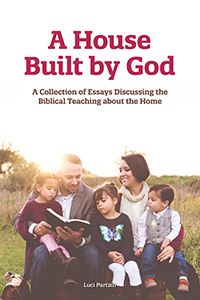
NEW RELEASE: A House Built by God

We are happy to announce that our newest book – A House Built by God: A Collection of Essays Discussing the Biblical Teaching about the Home by Luci Partain – is now available!

A House Built by God (cover)Download a sample of the book!

The home is the most fundamental unit of society, having been perfectly designed by God in the beginning. Yet the home as God designed it has been under attack by our godless culture. Divorce has become rampant, sexual purity has been disregarded, gender roles have been ignored, and God has been forgotten in many households. As the home breaks down, it negatively affects society for generations and even impacts the Lord’s church.

A home must be built on seeking God, His instruction, His love, and His principles of righteousness. Sister Luci Partain has written extensively in defense of God’s design for the home. This book contains a collection of essays on this topic, showing how we can work to have a house built by God today.

Read more about this new book and purchase your copy today!

If you would like to place a bulk order, please contact us.

Special Offer

For a limited time, save $3.69 off this book when you place an order through the Gospel Armory Store!

NOTE: Due to a longer than normal production time, we had to push back the announcement for this release. Our pre-orders have been sent out and more are on the way. Because of this, we’re extending the special offer to August 24, 2020. Place your order today!

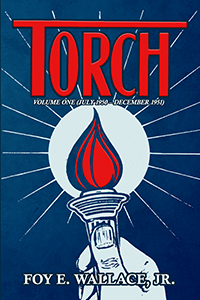
NEW RELEASE: Torch

We would like to announce our newest title – TORCH by Foy E. Wallace, Jr. – is now available.

Torch (cover)Foy E. Wallace, Jr. (1896-1979) was one of the most influential preachers among churches of Christ in the twentieth century. In 1950 he started publishing Torch, a personal periodical consisting mainly of his own writings. He continued publication for twelve issues. Through this magazine he addressed such issues as premillennialism, modernism, sponsoring churches, institutionalism, and more. He also wrote about his labors as he traveled to various places across the country to preach the gospel. With the Biblical teaching and historical information contained in it, this volume is a valuable resource for brethren today in studying the Scriptures and understanding the issues which affected brethren of Wallace’s day.
Download a sample of the book!

Read more about the book and purchase your copy today!


This is the twenty-first release in our Ancient Landmarks Collection. This collection is made up of materials that have been produced by those associated with the Restoration Movement. More titles will be added to this collection in the future. Be sure to subscribe to our mailing list to be notified of new releases.

Rules for Studying the Bible

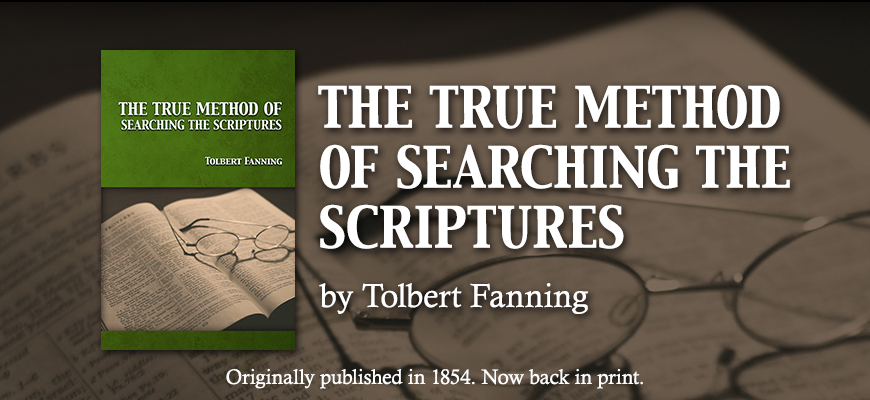
The True Method of Searching the Scriptures

RULE I: We must be satisfied, before we can read the Scriptures understandingly or profitably, that our kind Father intended them for his erring children of earth.

RULE II: In reading the Bible, the study of words is not to be disregarded.

RULE III: We should read, not to prove a system, but to learn the truth.

RULE IV: We should read the Bible with the idea that God is his own interpreter, and he has made it plain.

RULE V: The different portions of the Scriptures should be read with direct reference to their legitimate connections.

RULE VI: In reading, attention should be given to the character of the persons addressed.

RULE VII: The proper division of the Bible should be constantly before the mind of the reader.


The above post is an excerpt from the book, The True Method of Searching the Scriptures by Tolbert Fanning. Follow the link to learn more about the book and purchase your copy today!

Reading the Bible with Uncertainty

The True Method of Searching the Scriptures

Years ago, in our travels, we spent a night at a town in a southern state and heard the following conversation with the lady who presided at the supper table. She was asked:

“Are you a member of any church?” The lady in a feeble voice replied, “No.” “Why are you not?” “I could not get religion.” “Did you try?” “Yes,” was the reply, “I tried several years, and when I saw many succeed so easily, I felt that there was none for me; and I have not prayed since.” “Do you read the Bible?” said the fair inquirer. “Not now,” said the woman, with a sad heart. “Why do you not read?” Said she, “I cannot understand the Bible; and when I saw, many years ago, that I could not understand the Scriptures, I quit reading.” The next question asked was; “What part of the Bible did you read, to learn how to become a Christian?” “Oh!” said the lady, “I was not particular; I found very pretty reading in Job, the Psalms, and more; I believe in Proverbs.”

The reader will discover that this honest yet deluded daughter of an old preacher was looking up and down the Scriptures hoping that she would, by chance, light upon some place that would show her how to “get religion.” Her friends knew not how to direct her and were, indeed, so shamefully ignorant that they could not inform her; religion is not something which people “get,” but a practice. James 1:26. She had no idea of the object of the books of the Old or New Testament, and presumed she would as likely learn how to become a Christian from the Proverbs of Solomon, the Psalms of David, or the distresses of poor, old, afflicted Job, as any part of the New Testament. Her father ought to have been able to teach her that the Old Testament was not written for the purpose of giving information in reference to becoming the disciples of Jesus Christ. Indeed, she ought to have known, that it was written long before Christ was born or Christianity was revealed; and that Job, David and Solomon, all died looking for better things, but were not permitted to see the rising of the Sun of righteousness with healings in his wings.

If we are not mistaken, thousands of sincere persons read the Bible with quite as much uncertainty as this good woman; and it is to them, so far as intelligence is concerned, a sealed book.


The above post is an excerpt from the book, The True Method of Searching the Scriptures by Tolbert Fanning. Follow the link to learn more about the book and purchase your copy today!