We Must Avoid Sin and Keep a Clear Conscience

The Psalm of the Word: A Study of Psalm 119

They also do no unrighteousness; they walk in His ways” (Psalm 119:3).

Then I shall not be ashamed when I look upon all Your commandments” (Psalm 119:6).

Many believe that Christians can “continue in sin” (Romans 6:1) without concern. Paul refuted this error and asked the question: “How shall we who died to sin still live in it?” (Romans 6:2). Jude indicated that those who teach this error have perverted the word of God by turning it into a “license for immorality” (Jude 4, NIV).

Our goal must be to “do no unrighteousness” (Psalm 119:3). John said that his first epistle – and by principle, all of the Bible – was written “so that you may not sin” (1 John 2:1). God’s “commandments are righteousness” (Psalm 119:172). Paul wrote, “All Scripture is inspired by God and profitable for teaching, for reproof, for correction, for training in righteousness” (2 Timothy 3:16). In order to “do no unrighteousness” (Psalm 119:3) and “not sin” (1 John 2:1), we must follow the righteous instructions found in God’s word.

David also indicated that God’s people should keep a clear conscience (Psalm 119:6). However, this does not mean that we keep ourselves free from guilt by ignoring God’s word and adopting a human standard. Paul persecuted Christians in good conscience (Acts 23:1). Our conscience must be trained by the word of God (Hebrews 5:13-14). Once our conscience is properly trained and we observe the commandments of God, we will not need to be ashamed as we examine our lives by God’s perfect standard.


The above post is an excerpt from the book, The Psalm of the Word: A Study of Psalm 119. Follow the link to learn more about the book and purchase your copy today!

NEW RELEASE: The Psalm of the Word

The Psalm of the Word (cover)We would like to announce our newest title – The Psalm of the Word: A Study of Psalm 119 by Andy Sochor – is now available. This material contains an in-depth study of Psalm 119.

With its 176 verses, Psalm 119 is the longest chapter in the Bible. It is divided up into twenty-two stanzas of eight verses each. The entire psalm is dedicated to a single theme – the word of God.

The Psalm of the Word breaks down this psalm and discusses one stanza per chapter. Although the twenty-two stanzas each focus on the same theme (God’s word), the depth of the subject means that each stanza is unique, focusing on different aspects of God’s word – what it is, what it does for us, and what it requires of us.

These lessons are designed to help the reader come to a better understanding of God’s word and develop a greater appreciation of the truth that has been revealed in Scripture. Read more about the book and purchase your copy today!

Why Have the Class at All?

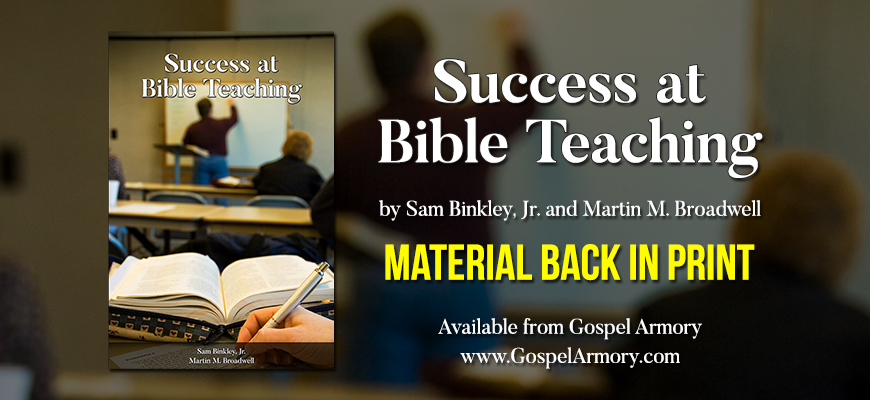
Success at Bible Teaching

As ridiculous as it may seem, there are many times when we conduct classes without ever really deciding exactly what it is we’re trying to accomplish. It may be that someone says, “We ought to have a class for the young married couples. After all, we’ve got so many of them, it would make a good class.” This isn’t to say that it wouldn’t be a good idea to have a class for the young couples, but it is to say that there ought to be a better reason for having it than just that “we’ve got a lot of them.” Other classes fall into the same category. We have ladies’ Bible classes sometimes for no better reason than that “We’ve always had them.”

Ideally, there should be a need before we have the class. If there is, then there should also be some idea of what is going to be covered, what the group can expect to learn, how long it will take to get there, and when they can expect to finish the course.

For example, if we’re going to have a young married couples’ class, we should decide ahead of time what it is they need, either from a look at what they’ve studied before, from their background, or from talking to them. We should be thinking about making up a weakness in their Bible background or solving problems they might have in their newly married status. It isn’t likely that we should start the class then decide that this would be a good time to study the book of Acts, 2 Samuel or Hebrews. To get the excitement needed to launch the class to keep the enthusiasm going to a successful conclusion, they should know that they are going to study a specific subject like “The Christian Home” or “Bible Couples” or “Young Men and Women in the Bible.” If material isn’t available, this is an excellent time to let the group do some good Bible searching. Assign different ones to come up with a family each week or report on different aspects of the Christian home. With just a little guidance, they can have a “funtime” and learn a tremendous amount at the same time. As we have said, though, there needs to be a projected purpose and stated ending time for the study whether six weeks or six months. That way, they can keep their enthusiasm up and know that they are learning a specific thing in a specific time frame.


The above post is an excerpt from the book, Success at Bible Teaching. Follow the link to learn more about the book and purchase your copy today!

Error Can Be Taught Innocently

Success at Bible Teaching

Not everyone who teaches error sets out to do so deliberately. It is possible for one to teach error without knowing that it is error. Apollos was an eloquent man and mighty in the scriptures, but he knew only the baptism of John until Priscilla and Aquila took him aside and taught him the way of the Lord more accurately (Acts 18:24-26). Paul was in ignorance when he was opposing Christ (1 Tim. 1:13). There are doubtless a great number of people today who believe they are teaching the truth, but who are in reality teaching error. For this reason Bible teachers continually need to take heed unto ourselves and the doctrine that we may be able to save ourselves and others (1 Tim. 4:16).

The responsibility of Bible teachers is great. Our own souls are at stake and so are the souls of those we teach. Therefore we need to know the difference between the truth which saves (John 8:32; 1 Pet. 1:22) and the errors of men which damn the soul (2 Thess. 2:10-12). We also need to help our students to be able to make this distinction and follow truth in the face of all opposition.


The above post is an excerpt from the book, Success at Bible Teaching. Follow the link to learn more about the book and purchase your copy today!

What’s the Best Teaching Technique to Use?

Success at Bible Teaching

Many times people will ask, “What’s the best teaching technique to use?” That’s a lot like asking a housewife, “What’s the best cooking utensil to use?” The best technique to use is the one that works the best with the subject being taught, the students being taught and the ability of the person doing the teaching. There are some measures, however. The best techniques are those that get the most involvement, provide the teacher and the learner with the most and best feedback possible, and fit the time limits of the class period. The more the students are involved, the better the pacing will be for their individual learning. The more the teacher does, the more the pacing is set for the teaching instead of the learning. When the teacher does all the talking, time is constant and learning is the variable, since each student learns at a different pace, but the teacher is putting out the information at only one rate. As the students get more and more involved, the pace becomes more suited to their individual needs, and can even vary with each person participating. Now learning is becoming constant while time may vary from one student to the next.


The above post is an excerpt from the book, Success at Bible Teaching. Follow the link to learn more about the book and purchase your copy today!