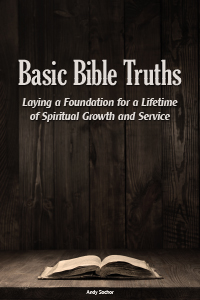
NEW RELEASE: Basic Bible Truths

Basic Bible Truths (cover)We would like to announce our newest title – Basic Bible Truths: Laying a Foundation for a Lifetime of Spiritual Growth and Service by Andy Sochor – is now available.

Basic Bible Truths addresses some fundamental topics from the word of God in order to lay a foundation for further study and growth for the reader. The book contains the following chapters:

  1. What Is the Bible?
  2. What Is the church of Christ?
  3. What Must I Do to Be Saved?
  4. By What Authority?
  5. If You Have Been Raised Up with Christ
  6. Studying the Bible
  7. Is Divine Revelation Ongoing Today?
  8. Is One Church As Good As Another?
  9. Worship in Spirit and Truth
  10. Grace, Faith, and Works
  11. Using Our Bodies As Instruments of Righteousness
  12. When Will the Lord Return?

These lessons are for non-Christians, new Christians, and also for more mature Christians who are seeking to teach these basic Bible truths to others. Read more about the book and purchase your copy today!

Download Sample

Caring For Our Bodies Better Than We Do For Our Souls

Plain Sermons (cover)“Man is what he eats.” This is an old saying, and it is as true of man spiritually as it is of him physically. Man’s body is made up of that which he eats, or receives into his system by eating, drinking, and breathing. The same is true of him educationally, socially, politically, morally and spiritually. In view of this we do not wish our bodies to be imposed on, nor poisoned, with impure foods. But we are not, generally, so careful about food for our souls. Though, as a rule, we do not take the best care of our bodies, yet we care for them better than we do for our souls. We wash our hands and faces several times each day, and pay some attention to the hairs of our heads. As a rule, we are much more concerned about the appearance of our bodies before mankind than we are about the appearance of our souls before God. If we go into a picture gallery and have a photograph taken of our facial expression we may be so pleased with it that we will order an extra dozen photos made to hand around among our friends. But suppose we could have a picture taken of our souls, especially if we have not fed them well on the word of God. We certainly would not wish the extra dozen of such pictures made. But what avails a well-kept, well-nourished body, if our souls are in a starving condition?


The above post is an excerpt from the book, Plain Sermons by Daniel Sommer. Follow the link to learn more about the book and purchase your copy today!

Truth Is Not Determined by Numbers

The Psalm of the Word: A Study of Psalm 119

Many are my persecutors and my adversaries, yet I do not turn aside from Your testimonies. I behold the treacherous and loathe them, because they do not keep Your word” (Psalm 119:157-158).

David’s adversaries were “many” (Psalm 119:157). He considered them, but he did not join them. Instead, he said he loathed them (Psalm 119:158).

We should take this as a reminder to not be tempted to join the majority. Jesus warned about this in the Sermon on the Mount: “Enter through the narrow gate; for the gate is wide and the way is broad that leads to destruction, and there are many who enter through it. For the gate is small and the way is narrow that leads to life, and there are few who find it” (Matthew 7:13-14). Popular opinion will change; but the truth of God’s word will not (Psalm 119:160). Therefore, we must not look at numbers to determine what is right; we must look to the Scriptures.


The above post is an excerpt from the book, The Psalm of the Word: A Study of Psalm 119. Follow the link to learn more about the book and purchase your copy today!

The Sum of God’s Word Is Truth

The Psalm of the Word: A Study of Psalm 119

The sum of Your word is truth, and every one of Your righteous ordinances is everlasting” (Psalm 119:160).

This twentieth stanza brings together some themes we have seen throughout this psalm. We have already seen in this psalm that God’s word is truth (Psalm 119:43, 142, 151). This same thought is expressed elsewhere in the Bible. In particular, we should note the passages from the New Testament. In Jesus’ prayer to the Father, He said, “Your word is truth” (John 17:17). Paul identified “the gospel” as “the word of truth” (Colossians 1:5; cf. 2 Timothy 2:15).

The reason why the Bible is the truth is because it is from God. He “cannot lie” (Titus 1:2). Because of this, the promises contained in His word serve as an anchor for us. The Hebrew writer made this point in his letter: “So that by two unchangeable things in which it is impossible for God to lie, we who have taken refuge would have strong encouragement to take hold of the hope set before us. This hope we have as an anchor of the soul, a hope both sure and steadfast and one which enters within the veil” (Hebrews 6:17-18). We can have hope because God’s word is right and cannot be wrong.

In considering this point, it is important to note that the sum of God’s word is truth. All of it is true because it is all from God. Paul told Timothy, “All Scripture is inspired by God and profitable for teaching, for reproof, for correction, for training in righteousness; so that the man of God may be adequate, equipped for every good work” (2 Timothy 3:16-17). Since all of the Bible is
from God, we can be confident that it is all true.

However, many will attack various parts of the Bible, claiming that they are not true, but instead are myths, lies, mistranslations, etc. This is commonly done with events like the Creation (Genesis 1), the crossing of the Red Sea (Exodus 14:15-31), and the resurrection of Jesus from the dead (Matthew 28:1-9; et al.). Yet if we reject parts of the Bible – as is often done with examples such as these – how can we believe any of it? The psalmist wrote, “If the foundations are destroyed, what can the righteous do?” (Psalm 11:3). Faith comes from the word of God (Romans 10:17); but if our faith in the integrity and veracity of the Scriptures is compromised, where does that leave our faith? Regarding the resurrection of Christ, Paul wrote, “If Christ has not been raised, your faith is worthless; you are still in your sins. Then those also who have fallen asleep in Christ have perished. If we have hoped in Christ in this life only, we are of all men most to be pitied” (1 Corinthians 15:17-19). If Jesus was not raised from the dead, our “faith is worthless.” In the same way, if we do not believe His resurrection really happened, our faith is just as worthless. We must always remember that the sum (entirety) of God’s word is truth.


The above post is an excerpt from the book, The Psalm of the Word: A Study of Psalm 119. Follow the link to learn more about the book and purchase your copy today!

We Must Recognize the Need for God’s Grace

The Psalm of the Word: A Study of Psalm 119

Turn to me and be gracious to me, after Your manner with those who love Your name” (Psalm 119:132).

Make Your face shine upon Your servant, and teach me Your statutes” (Psalm 119:135).

David appealed to God to turn to him (Psalm 119:132). Of course, he needed to turn to God as well (more on this point later); but nothing he would do would matter if God did not turn to him. Paul reminded the Gentiles, “Remember that you were at that time separate from Christ, excluded from the commonwealth of Israel, and strangers to the covenants of promise, having no hope and without God in the world. But now in Christ Jesus you who formerly were far off have been brought near by the blood of Christ” (Ephesians 2:12-13). If the Gentiles had turned to God but God had not accepted them, they would still be “far off.” God, through His grace, must be willing to accept someone; otherwise, nothing he does will be of any consequence.

Fortunately for us, God has extended His grace to all. But sadly, not all will receive it. Paul said, “The grace of God has appeared, bringing salvation to all men” (Titus 2:11). However, we know that not all will be saved (Matthew 7:13-14). In order to receive His grace, we must be among those who “love [His] name” (Psalm 119:132). We must recognize the need for God’s grace because He does not owe us anything – except punishment for our sins (Romans 6:23) – and we must respond with gratitude and obedience. “Whatever you do in word or deed, do all in the name of the Lord Jesus, giving thanks through Him to God the Father” (Colossians 3:17). Love, gratitude, and obedience are essential; but they mean nothing without God’s grace first being offered to us.

The psalmist also said, “Make Your face shine upon Your servant” (Psalm 119:135). This is another appeal for grace. This phrase is used several places in the Old Testament to refer to God’s grace (cf. Numbers 6:25; Psalm 67:1; 80:3, 7, 19).

David then tied this back to the word of God: “Teach me Your statutes” (Psalm 119:135). God extends His grace through His word, not apart from His word. The gospel is “the gospel of the grace of God” (Acts 20:24) and is, therefore, “the power of God for salvation” (Romans 1:16). But if we “do not obey the gospel,” we will be lost (2 Thessalonians 1:8). We cannot be saved without grace, but we cannot respond to God’s grace without His word.


The above post is an excerpt from the book, The Psalm of the Word: A Study of Psalm 119. Follow the link to learn more about the book and purchase your copy today!