
Many Other Signs

Plain Bible Study Guides

Read: John 20:30-31

John then added, “Therefore many other signs Jesus also performed in the presence of the disciples, which are not written in this book” (20:30). Even though there were four gospels written that discussed the life of Jesus, there were many things He did which were never recorded. However, John said, “But these have been written so that you may believe that Jesus is the Christ, the Son of God; and that believing you may have life in His name” (20:31). What has been recorded is there to lead us to belief so that we can be saved. The inspired record is sufficient to do this.


The above post is an excerpt from the John Study Guide. Follow the link to learn more about the book and purchase your copy today!
The Vine and the Branches

Plain Bible Study Guides

Read: John 15:1-8

Jesus began with an illustration of the vine and the branches. His teaching is straightforward and easily understood, yet many have misunderstandings about it.

There are three parties depicted in the illustration – the vine, the vinedresser, and the branches. Jesus explained, “I am the true vine, and My Father is the vinedresser” (15:1). Identifying the vine and vinedresser is obvious from the first verse, but who are the branches? “I am the vine, you are the branches” (15:5).

It is important that we understand that when Jesus said, “You are the branches” (15:5), He was speaking to individuals. Many in the religious world, in their attempt to justify denominationalism, claim that the branches are denominations. In other words, the Baptist church, Methodist church, Lutheran church, and so on are all branches that grow off of – yet are still connected to – the vine (Jesus). However, Jesus made it clear that He was referring to individuals as the branches. Notice the words He used: “I am the vine, you are the branches; he who abides in Me and I in him, he bears much fruit, for apart from Me you can do nothing. If anyone does not abide in Me, he is thrown away as a branch” (15:5-6). The branches in Jesus’ illustration can only refer to individual disciples.

The disciples, as branches, were expected to bear fruit (15:2). Even today, this means that Jesus’ disciples must be actively serving Him. However, it is not enough to do just anything we decide to do in His service (cf. Matthew 7:21-23); we must do what He has instructed. This was the point of Jesus’ statements: “The branch cannot bear fruit of itself unless it abides in the vine,” and, “For apart from Me you can do nothing” (15:4-5). That does not mean that if they fell away they would be incapable of any action; instead, it meant that if they quit following the instructions of Christ, they would not be able to please Him and bear the proper fruit.

Those who do not bear fruit will be taken away (15:2). Jesus said, “If anyone does not abide in Me, he is thrown away as a branch and dries up; and they gather them, and cast them into the fire and they are burned” (15:6). This is a reference to divine judgment against those who failed to faithfully serve Him.

Those who do bear fruit “prove to be [Jesus’] disciples” (15:8). They will then be pruned so that they can bear more fruit (15:2). This is referring to the continued growth and maturity that will necessarily take place as Jesus’ disciples faithfully serve Him. These disciples were “already clean” or pruned “because of the word” that Jesus taught them (15:3). In fact, Jesus told them, “If you abide in Me, and My words abide in you, ask whatever you wish, and it will be done for you” (15:7). This promise for asking and receiving was specifically for the apostles (cf. 14:13-14; 15:16; 16:23). Yet this also teaches us how we abide in Jesus – by having His words abide in us. When His word abides in us, we will bear fruit (15:4-5).


The above post is an excerpt from the John Study Guide. Follow the link to learn more about the book and purchase your copy today!

Words of Eternal Life

Plain Bible Study Guides

Read John 6:66-70

After Jesus’ teaching in the synagogue, the crowd left. Rather than panicking about losing so many followers, as we might have been tempted to do, He offered His twelve disciples a chance to leave as well (6:66-67). Peter spoke up and explained why they could not leave: “Lord, to whom shall we go? You have words of eternal life” (6:68). Peter understood what the crowd failed to understand – one must follow the words of Christ if he hopes to have eternal life. We must do the same.


The above post is an excerpt from the John Study Guide. Follow the link to learn more about the book and purchase your copy today!

Not One Gospel Fact, Command, or Promise

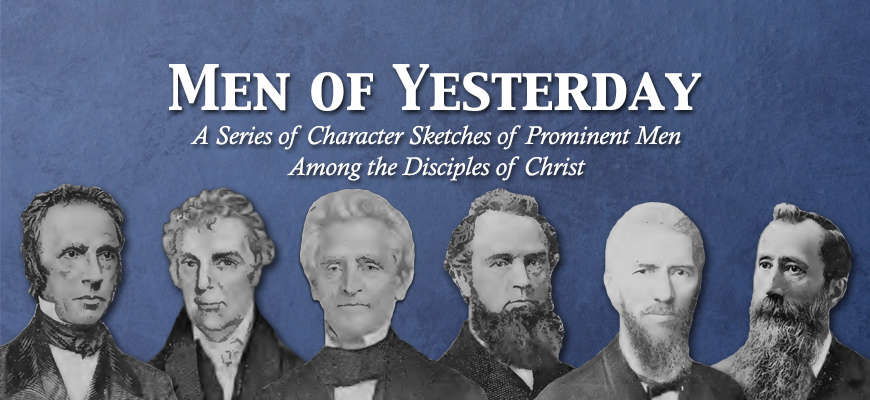
Men of Yesterday

For several years past, I have stood pledged to meet the religious world, or any part of it, on the ancient Gospel and order of things, as presented in the words of the Book. This is the foundation on which Christians once stood, and on it they can, and ought to, stand again. From this I can not depart to meet any man, or set of men, in the wide world. While, for the sake of peace and Christian union, I have long since waived the public maintenance of any speculation I may hold, yet not one Gospel fact, command, or promise, will I surrender for the world.

—John Smith


The above post is an excerpt from the book, Men of Yesterday: A Series of Character Sketches of Prominent Men Among the Disciples of Christ by Thomas W. Grafton. Follow the link to learn more about the book and purchase your copy today!

One Ray of Glory

Men of Yesterday

I believe the Father sent the Son to be the Savior of the world, that whosoever believeth on him might not perish, but have everlasting life. I believe that all power and authority in heaven and earth are given unto him and that he is able to save unto the uttermost all that come to God by him; that in him are all the treasures of wisdom and knowledge; that it pleased the Father that in him should all fulness dwell, the fulness of the Godhead, the fulness of the Spirit, the fulness of grace and salvation. When we see him we see the Father, his image, his character, his glory, and his perfection. Let me lose my life before I would detract from my Lord one ray of glory.

—Barton W. Stone


The above post is an excerpt from the book, Men of Yesterday: A Series of Character Sketches of Prominent Men Among the Disciples of Christ by Thomas W. Grafton. Follow the link to learn more about the book and purchase your copy today!