Example to Others

Sermon on the Mount: Instructions for Life

You are the salt of the earth; but if the salt has become tasteless, how can it be made salty again? It is no longer good for anything, except to be thrown out and trampled under foot by men. You are the light of the world. A city set on a hill cannot be hidden; nor does anyone light a lamp and put it under a basket, but on the lampstand, and it gives light to all who are in the house. Let your light shine before men in such a way that they may see your good works, and glorify your Father who is in heaven” (Matthew 5:13-16).

Jesus used three analogies to emphasize the fact that we are to be examples to others. First, He said that we are “the salt of the earth” (Matthew 5:13). Salt is a preservative. Of course, this does not mean that if we can increase the number of righteous people in the world, then God’s judgment will be delayed. Paul told the Athenians that God has “fixed a day in which He will judge the world in righteousness” (Acts 17:31). Instead, we act as a “preservative” in that by living righteously, we are preserving what is good and right on the earth. By our righteous example, we are showing others what is right and encouraging them by our influence to be good as well.

Second, Jesus said we are “the light of the world” (Matthew 5:14). Light is important because it shows the way. The psalmist wrote, “Your word is a lamp to my feet and a light to my path” (Psalm 119:105). Again, by our example as we are directed by the word of God, we are showing others the way that they should go. Paul encouraged the brethren in Philippi to be different from the world: “Prove yourselves to be blameless and innocent, children of God above reproach in the midst of a crooked and perverse generation, among whom you appear as lights in the world” (Philippians 2:15). Jesus explained the clear and unmistakable difference between right (light) and wrong (darkness): “This is the judgment, that the Light has come into the world, and men loved darkness rather than the Light, for their deeds were evil. For everyone who does evil hates the Light, and does not come to the Light for fear that his deeds will be exposed” (John 3:19-20). Those who do right – as long as they do not compromise – will not blend in with those who do wrong. By our actions, we highlight the contrast between right and wrong.

Third, Jesus described His disciples as “a city set on a hill” (Matthew 5:14). This means we are highly visible, emphasizing again our example. Not only is a city on a hill highly visible, but it is also in a position of strength. The wise man wrote, “The name of the Lord is a strong tower; the righteous runs into it and is safe” (Proverbs 18:10). Those who are righteous have the strength of God to protect them. We are to live righteously because we trust in God to save us.

Our righteousness should be visible to others. Jesus said that others should “see your good works, and glorify your Father who is in heaven” (Matthew 5:16). We are to be an example to others in all that we do. The way we do this is through righteous living.


The above post is an excerpt from the book, Sermon on the Mount: Instructions for Life. Follow the link to learn more about the book and purchase your copy today!
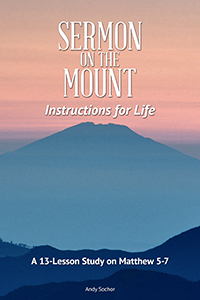
NEW RELEASE: Sermon on the Mount

Sermon on the Mount (cover)We would like to announce our newest title – Sermon on the Mount: Instructions for Life by Andy Sochor – is now available.

In the Sermon on the Mount, Jesus gave instructions for the life of a disciple. As people came to follow Him, He wanted them to be sure they understood what it meant to be His disciple. So He provided them with instructions showing the type of life they would be called to live. Jesus explained that the life of a disciple is:

  1. A blessed life
  2. A righteous life
  3. A sincere life
  4. A focused life
  5. A just life
  6. A different life

This material breaks down Jesus’ sermon in Matthew 5-7 into 13 lessons with questions at the end of each one, making it helpful for both personal and group Bible studies. Read more about the book and purchase your copy today!

If you would like to place a bulk order, please contact us.

Download Sample

Anxious to See the Finest Young Men as Preachers

The Reformation For Which We Are Pleading: A Collection of Articles by Moses E. Lard

I am profoundly anxious to see the very finest young men of the land in the field as preachers. But till more ample provision has been made to meet their wants, is it right to invite them in? Is it just—just to them or just in itself? It will not do to talk prettily of providence and the goodness of God. Providence and the goodness of God never yet supported a preacher in a community of illiberal brethren. Where brethren withhold, providence is stringent. It is cheap talk to tell a young man to go forth nobly to the work, trusting in God. Certainly we must not distrust God; but God has ordained that they who preach the gospel shall thereby live. He will support them in no other way. Neither will he work a miracle to make men liberal. When Christians do nothing, the Lord does nothing, except to hold them guilty. Depend on this, whatever is done for preachers has to be done by the brethren, else it will not be done at all. God has placed his treasure in their hands, and expects them to dispense it. There remains to us no other source.


The above post is an excerpt from the book, The Reformation For Which We Are Pleading: A Collection of Articles by Moses E. Lard. Follow the link to learn more about the book and purchase your copy today!

Genuine Methodists and Baptists

The Reformation For Which We Are Pleading: A Collection of Articles by Moses E. Lard

Is a genuine Methodist, then, a true Christian? It would certainly give offense were I to deny it. Be it so, then, at least for the present. But is a genuine Baptist also a true Christian? Let this too be granted. A genuine Methodist, is a true Christian; and a genuine Baptist is a true Christian. Now certainly things which are equal to the same third are equal to one another. Therefore a genuine Baptist is a true Methodist; and a genuine Methodist a true Baptist. Now this conclusion we know to be false; yet it could not be false were a genuine Baptist a true Christian neither more nor less, and a genuine Methodist the same.


The above post is an excerpt from the book, The Reformation For Which We Are Pleading: A Collection of Articles by Moses E. Lard. Follow the link to learn more about the book and purchase your copy today!

Calvinism in its Most Loathsome Form

The Reformation For Which We Are Pleading: A Collection of Articles by Moses E. Lard

Here it may be well to pause long enough to note the fact, that Calvinism in its most loathsome form, and the doctrine of original sin, different though they are, yet land their votaries very near the same mark. Calvinism places infants in hell, for no crime whatever, either of the parent or the child, personal or transmitted. Original sin places them there, for no sin of the child, but for a transmitted one of the parent. According to neither is the infant placed in hell for its own sin. Both, then, alike make God the author of the damnation of the innocent. In other words, both represent God as creating some infants for no purpose but to damn them, and as damning them for no reason except that he has created them. The difference between the two doctrines just at this point is a difference not worth drawing.


The above post is an excerpt from the book, The Reformation For Which We Are Pleading: A Collection of Articles by Moses E. Lard. Follow the link to learn more about the book and purchase your copy today!