Can We Trust the Commentaries?

How to Study the Bible

Can we trust the commentaries? The answer rests in how well you trust your own understanding of the scriptures. We must never accept the teachings of any man merely because we like him or the “oratory sounds reasonable.” Some commentators never obeyed the gospel of Christ. We would never permit such a person to occupy our pulpits or teach in our classes: yet many quote their words of commentary with as much frequency and authority as the gospel itself! Other commentators have published very fine materials after years of study and painstakingly proven research. Still, these are merely men with no more reading and thinking ability than you have! “Search the scriptures,” says Jesus (John 5:39). Let that be our primary study book! (Colossians 1:18)


The above post is an excerpt from the book, How to Study the Bible by Michael J. Davis. Follow the link to learn more about the book and purchase your copy today!

Bible Study – Like Getting Water from a Well

How to Study the Bible

The individual’s obligation is to learn of Christ (Matthew 11:28-30). There is no limitation as to how much scripture you may learn. In fact, the danger is in not learning enough of God’s Word (Matthew 4:4). Our study of God’s Word must be a daily task (2 Corinthians 4:16). You can never exhaust the Word of God.

As a child, I often studied the Bible with my grandmother Davis. When we finished, she would let me go to her well and draw a fresh bucket of water. She would tell me, “Bible study is a lot like getting water from my well. Every time you let the bucket down you get water; but it is a bucket of water you never had before.” She was right!


The above post is an excerpt from the book, How to Study the Bible by Michael J. Davis. Follow the link to learn more about the book and purchase your copy today!

NEW RELEASE: How to Study the Bible

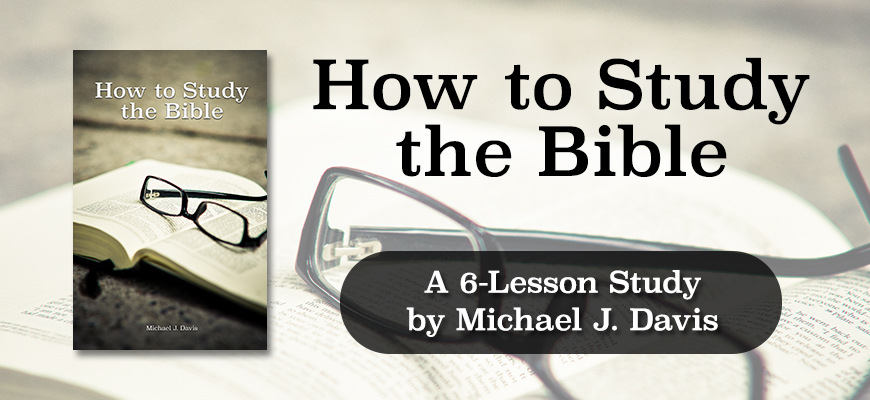
How to Study the Bible (cover)We would like to announce our newest title – How to Study the Bible by Michael J. Davis – is now available.
Studying the Bible is the most rewarding effort any soul will ever perform. Yet we must choose to take the time and effort necessary to engage in profitable study. This material has been written to encourage each one of us to be a diligent student of the Bible so that we might gain the most from it.

This is a 6-lesson study about learning how to study the Bible. It may be used individually or with a group.

Read more about the book and purchase your copy today!

If you would like to place a bulk order, please contact us.

Download Sample

Lessons in the Religious Observances

Plain Bible Study Guides

It is important that we remember the lessons for us in the regular observances the Israelites were given. Though we are no longer under the same law, the reminders are just as necessary.

  • The sabbath each week was a reminder of God’s work as the Creator (23:3; Exodus 20:8-11). We must also remember the lessons about God from the Creation (Romans 1:20).
  • The Passover was a reminder that God spared the Israelites from the plague of death (23:5; Exodus 12:24-27). Jesus is “our Passover” (1 Corinthians 5:7) who saves us from death (Romans 5:8-10).
  • The Feast of Unleavened Bread was observed with the removal of all leaven from their houses (23:6-8; Exodus 12:15). In the New Testament, leaven is used to symbolize sin (1 Corinthians 5:6-8). This reminds us of the need for purity as we are to remove sin from our lives (1 John 3:3).
  • The Feast of First Fruits required the people to bring the first of their produce (23:9-14). This is a reminder of the need to put God first in all things (Matthew 6:33).
  • The Feast of Weeks also required the people to offer to God of the fruit of the ground (23:15-22). It is a reminder of God’s ongoing providence as He blesses us with what we need in this life (Acts 14:17).
  • The day of atonement provided a yearly reminder of sin and the need for forgiveness (23:26-32; cf. 16:1-34). Jesus made atonement for us on the cross, making forgiveness possible (Romans 5:10-11; Matthew 26:28).
  • The Feast of Booths required the people to live in tents to remind them of their time in the wilderness after leaving Egypt (23:33-44). In the same way, we need to remember that our time on earth is only temporary (Matthew 6:19-21; 2 Corinthians 5:1).

The above post is an excerpt from the Leviticus Study Guide. Follow the link to learn more about the book and purchase your copy today!

Instructions About Sin

Plain Bible Study Guides

There are two main points to take from these instructions about sin that we can apply to us.

Avoid Sin

In these laws, we can see God’s attitude toward sin. He does not look favorably on sin and expects His people to strive avoid it. As Christians, we are to “consider [ourselves] to be dead to sin” (Romans 6:11) and strive to “be perfect, as [our] heavenly Father is perfect” (Matthew 5:48). We are not to have the attitude of the Romans who thought they could “continue in sin so that grace [would] increase” – Paul explicitly condemned that mentality since Christians have “died to sin” and must not “still live in it” (Romans 6:1-2). Some today are like those that Jude warned about – “ungodly people, who pervert the grace of our God into a license for immorality” (Jude 4, NIV). We are not to take God’s grace as permission to sin but as a call to repudiate sin (cf. Titus 2:11-12).

Be Distinct from the World

Just as the children of Israel were to be distinct from the nations around them, we must be distinct from the world. Paul said we must “not be conformed to this world, but be transformed by the renewing of [our] mind” (Romans 12:2). He told the brethren in Corinth, “‘Come out from their midst and be separate,’ says the Lord, ‘And do not touch what is unclean; and I will welcome you’” (2 Corinthians 6:17). Just as the Israelites were called to be holy (19:1-2), we as Christians must be also. Peter wrote, “But like the Holy One who called you, be holy yourselves also in all your behavior; because it is written, ‘You shall be holy, for I am holy’” (1 Peter 1:15-16).


The above post is an excerpt from the Leviticus Study Guide. Follow the link to learn more about the book and purchase your copy today!