Peace, Peace, Quiet Peace

The Good Church At Philippi

“Be careful for nothing; but in every thing by prayer and supplication with thanksgiving let your requests be made known unto God. And the peace of God, which passeth all understanding, shall keep your hearts and minds through Christ Jesus” (Phil. 4:6-7).

Paul wrote in this letter to the good church at Philippi several times about joy. A sure thing that will deprive a Christian of the joy Paul speaks of is anxiety. Yet there is an antidote for anxiety—prayer.

Yes, any number of situations may arise to give us anxious moments. During these situations we could spend our time “stewing” over the problems. What would be gained in such activity? Perhaps we should pause and reflect that the “stewing” time could be time spent in prayer over the same situations.

One thing needs to be said here. Paul is not saying that a Christian should care for nothing. There certainly are legitimate concerns in life, but even legitimate concerns can be elevated into major distractions. A careful reading of Matthew 6:25-33 will reveal this very point. God knows we have need of these things, but we cannot let them have control of our lives. Let us not be consumed with these things, we have help in an ally of whom it is said that we should be found “…casting all your care upon Him, for He cares for you” (1 Peter 5:7). When this is done, a great burden is lifted and the Christian can have peace, peace, quiet peace. What peace it is that comes from knowing that we have such an ally in a caring God.

Sometimes the word peace is used in connection with reconciliation (Rom. 5:1; etc.). Surely it includes that here AND also includes the comfort that comes from trusting in God. One said, “…the deep tranquility of a soul resting wholly upon God—the antithesis to the solicitude and anxiety engendered by the world and worldliness” (Elicit, p. 102-103).

The phrase “…passeth (surpasses, NKJV) all understanding…” is intriguing. We struggle with the meaning of it and acknowledge difficulty in doing so. When this peace is possessed, it shows immediately in those who have it. They are a calm in the midst of a storm, a source of amazement to others. “Doesn’t this bother you,” some might shout out. Of course it does, but they are handling it through prayer and trust in God. We understand the principle involved, but marvel at the result. Words escape us in our attempts to explain the state of such peace, peace, quiet peace. “The peace of God not only suffices to relieve anxiety, but surpasses or transcends human comprehen-sion” (Weaver, p. 219).

We are bombarded with advice on coping with stress. Books, tapes, seminars, et cetera are advertised and published with the purpose of alleviating stress in one’s life. I suppose millions of dollars are spent each year (maybe each month) on stress management. Though they may do some minimal and temporary good, they do not compare to the peace that is described in these verses. What you find here is real stress management.


The above post is an excerpt from the book, The Good Church At Philippi by Terry Sanders. Follow the link to learn more about the book and purchase your copy today!

Let the Mind of Christ Be in You

The Good Church At Philippi

“Let this mind be in you, which was also in Christ Jesus” (Phil. 2:5). What a powerful message is contained in these few words. It suggests that we can know the mind of Christ and have that mind within ourselves. It also indicates that a Christian can successfully imitate Christ.

Both of the last two sentences I have written in the preceding paragraph are problematic to a number of people, even to some brethren. There are those who intimate that it is impossible to know the mind of Christ. If that is so, then we must be left to guess what mind ought to be in us. Furthermore, if we cannot know the mind of Christ, then everyone would be right and no one wrong in guessing what that mind should be. There are also some who think it a terrible thing to suggest that one can be Christ-like. I suppose that such thinking is a “carry over” from the Calvinistic notion of total inherited depravity. This view says that man is wicked at birth and only gets worse (????). To those who hold this point of view, it is shocking that depraved, miserable wretches dare think they could imitate Christ. However, Philippians 2:5 (as well as many other passages) shows in a very succinct, positive manner that man can be what God’s word says he ought to be. A Christian can have the mind of Christ according to this verse!

Albert Barnes said it well when he wrote, “The principle in this case is, that we are to make the Lord Jesus our model, and are in all respects to frame our lives, as far as possible, in accordance with this great example” (p. 169). Peter said, “For even hereunto were ye called: because Christ also suffered for us, leaving us an example, that ye should follow his steps” (1 Peter 2:21). Paul was an imitator of Christ and encouraged others to do likewise (1 Cor. 11:1, NKJV).

Jesus has shown us a pattern in a number of areas and we should follow that pattern. He has shown us:

  1. What obedience to God is all about (Jn. 4:34).
  2. How to treat one another (Jn. 13:34-35).
  3. How to live in a materially-minded world (Matt. 6:19-20; 8:20).
  4. How to suffer injustice (1 Peter 2:23).
  5. How to die (Lk. 23:46).

Paul had an earnest hope that the good church at Philippi would have the mind of Christ. We should reflect often upon these things and strive to see them in our lives also.


The above post is an excerpt from the book, The Good Church At Philippi by Terry Sanders. Follow the link to learn more about the book and purchase your copy today!

The Greatest Question

Torch

The question of all questions is “What think ye of Christ?” What one thinks of Christ determines his thoughts and actions on every question. The correctness of faith depends on the correct answer to the superlative question—“What think ye of Christ?” The question of how and when one is saved by faith through Christ is answered when the first question is resolved. The value of faith in salvation is determined by the use that is made of faith. How faith is to be used must be decided by what the gospel of Christ says; for apart from the testimony of the divine records no one can settle any question as to salvation through Christ.

Before all men today there are two plans of salvation offered. One is of human origin, and contradicts the teaching of Christ and his apostles. The other is Jesus Christ’s own plan, and it was revealed through the apostles.

Since the time of Martin Luther the doctrine of justification by faith alone has been taught as a leading theological tenet. It is taught in opposition to the teaching of Christ through his apostles. We should and we do emphasize justification by faith, as the apostles of the Lord taught it, but we refuse to add the word “alone,” and because we refuse to do that we are charged with teaching justification by works and water salvation. Paul and all of the apostles taught justification by faith, but never did they say faith alone. Why? “There’s a reason,” as certain advertising reads, and quite a sufficient reason. First, they would have contradicted the commission of Mark 16:15-16 which gave them authority to preach. Second, they knew that faith is a continuing state of mind. Faith was to be ever present, hence a life of faith. Hence, Paul said “Christ liveth in me.” Do you ask how? “The life which I now live in the flesh I live by the faith of the Son of God” (Gal. 2:20). Thus Paul teaches that faith is ever present, all through life, and is directed all of the way by “the faith” of Christ. All students of language know that we may employ transposition of clauses in a sentence without changing its meaning, but rather making its meaning clearer. Transposing Rom. 1:16 it reads: “To every one that believeth it (the gospel) is the power of God unto salvation.” So here is the order: (1) There is a believer; (2) the believer is in possession of “the power” that is “unto” salvation; (3) when that “power” is used, the believer becomes saved. Power is necessary to the accomplishment of anything, physical or spiritual. The power must be used before there can be results. The power unto salvation is the gospel. That power and the use of it stands between the believer and salvation. Is the believer saved before and without the use of the power which is “unto”—in order to—his salvation? Who can imagine results without the use of the power necessary to the results? Thus it is that this passage, and every other passage quoted as a faith alone text, condemns the doctrine of salvation at the moment one believes.

What one thinks of Christ is determined by what he thinks of the gospel of Christ.


The above post is an excerpt from the book, TORCH by Foy E. Wallace, Jr. Follow the link to learn more about the book and purchase your copy today!

Rules for Studying the Bible

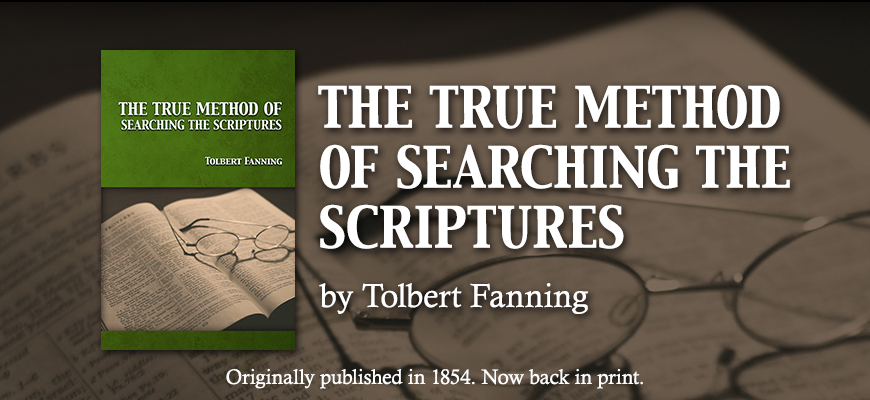
The True Method of Searching the Scriptures

RULE I: We must be satisfied, before we can read the Scriptures understandingly or profitably, that our kind Father intended them for his erring children of earth.

RULE II: In reading the Bible, the study of words is not to be disregarded.

RULE III: We should read, not to prove a system, but to learn the truth.

RULE IV: We should read the Bible with the idea that God is his own interpreter, and he has made it plain.

RULE V: The different portions of the Scriptures should be read with direct reference to their legitimate connections.

RULE VI: In reading, attention should be given to the character of the persons addressed.

RULE VII: The proper division of the Bible should be constantly before the mind of the reader.


The above post is an excerpt from the book, The True Method of Searching the Scriptures by Tolbert Fanning. Follow the link to learn more about the book and purchase your copy today!

Reading the Bible with Uncertainty

The True Method of Searching the Scriptures

Years ago, in our travels, we spent a night at a town in a southern state and heard the following conversation with the lady who presided at the supper table. She was asked:

“Are you a member of any church?” The lady in a feeble voice replied, “No.” “Why are you not?” “I could not get religion.” “Did you try?” “Yes,” was the reply, “I tried several years, and when I saw many succeed so easily, I felt that there was none for me; and I have not prayed since.” “Do you read the Bible?” said the fair inquirer. “Not now,” said the woman, with a sad heart. “Why do you not read?” Said she, “I cannot understand the Bible; and when I saw, many years ago, that I could not understand the Scriptures, I quit reading.” The next question asked was; “What part of the Bible did you read, to learn how to become a Christian?” “Oh!” said the lady, “I was not particular; I found very pretty reading in Job, the Psalms, and more; I believe in Proverbs.”

The reader will discover that this honest yet deluded daughter of an old preacher was looking up and down the Scriptures hoping that she would, by chance, light upon some place that would show her how to “get religion.” Her friends knew not how to direct her and were, indeed, so shamefully ignorant that they could not inform her; religion is not something which people “get,” but a practice. James 1:26. She had no idea of the object of the books of the Old or New Testament, and presumed she would as likely learn how to become a Christian from the Proverbs of Solomon, the Psalms of David, or the distresses of poor, old, afflicted Job, as any part of the New Testament. Her father ought to have been able to teach her that the Old Testament was not written for the purpose of giving information in reference to becoming the disciples of Jesus Christ. Indeed, she ought to have known, that it was written long before Christ was born or Christianity was revealed; and that Job, David and Solomon, all died looking for better things, but were not permitted to see the rising of the Sun of righteousness with healings in his wings.

If we are not mistaken, thousands of sincere persons read the Bible with quite as much uncertainty as this good woman; and it is to them, so far as intelligence is concerned, a sealed book.


The above post is an excerpt from the book, The True Method of Searching the Scriptures by Tolbert Fanning. Follow the link to learn more about the book and purchase your copy today!